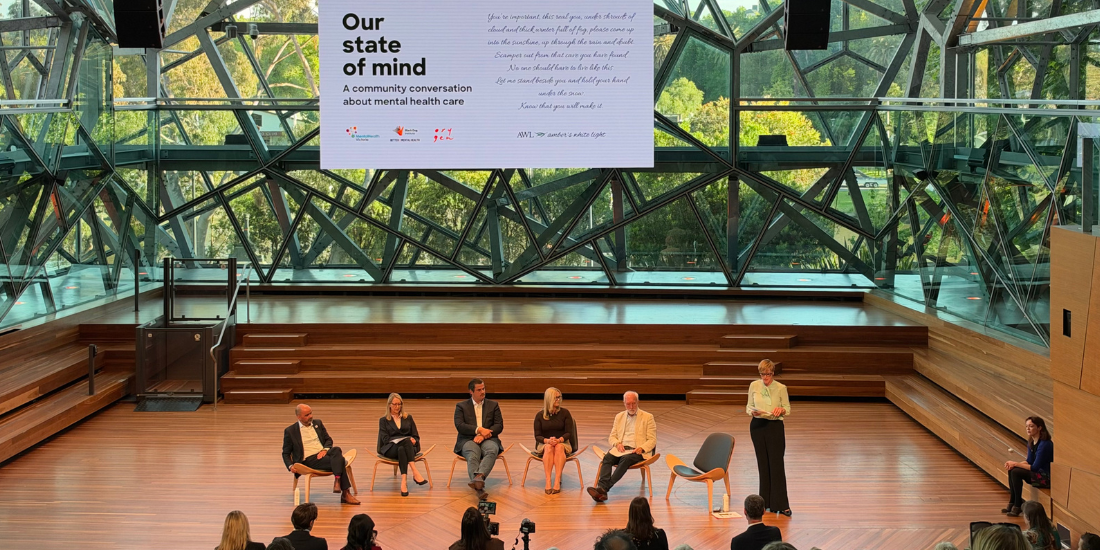
 Left to right: Prof. Samuel Harvey, Tamara Wraith, Tom Boyd, Phillipa Thomas, Prof. Pat McGorry, Zoe Daniel.
People in crisis not knowing where to turn, families desperate to help their loved ones, gaps in care and cracks in the system: stories from a night of mental health conversation at Federation Square exposed the raw, human side of Victoria's mental health crisis as experts and community members came together to call for change.
Our state of mind, an initiative of Mental Health Victoria (MHV), Orygen and the Black Dog Institute, brought together mental health leaders, advocates, people with a lived experience of mental ill health and community members to ask difficult questions – and propose workable solutions – to halt the alarming decline of mental health care across the state.
- MEDIA RELEASE: Mental Health Victoria, Orygen and Black Dog Institute have released a joint statement calling for mental health reform and continuity of care across the lifespan ahead of the Victorian election – read the full statement here.
With over 80 pre-submitted questions and a highly engaged audience on the night, two hours only scratched the surface of the deep insights, experiences and ideas held by community. Mental Health Victoria, Orygen and Black Dog Institute are committed to continuing to amplify community and sector voices.
The conversation was guided by former independent Member of Parliament and MHV Chair Zoe Daniel, panellists Professor Patrick McGorry (Orygen), Phillipa Thomas (MHV), Tom Boyd (advocate and former AFL player), Professor Samuel Harvey (Black Dog Institute) and Tamara Wraith (Amber’s White Light). The group were joined by a large crowd at Federation Square to listen, reflect on and seek answers to what Prof. McGorry called "solvable problems" in mental health care.
Across the evening a recurrent theme was unmistakable – exasperation and disbelief that despite having evidence of available solutions, the enormous burden and heartbreaking consequences of severe mental ill-health means individuals, their families, and communities across the state continue to struggle and suffer without the treatment care and support they need.
The political will and necessary funding is missing in action.
As Amber’s White Light co-founder Tamara Wraith put it, "life-threatening situations should lead to lifesaving care", rather than people being turned away from emergency departments while in crisis – but investment, coordination and evidence-based care remains lacking.
Former AFL premiership player Tom Boyd highlighted that “too much is being left to too few”, describing how he has “seen first-hand how the erosion of funding and investment in many parts of Victoria” has left individuals and families coping “on their own”.
Drawing parallels with physical health, panellists discussed the fragmented way mental ill-health is treated, pointing out that people experiencing life-threatening mental health conditions often receive uncoordinated and incomplete treatment – in stark contrast to the comprehensive treatment approach expected when someone is diagnosed with cancer.
Prof. McGorry described a lifetime's work "trying to get a fair go for people with severe mental illness," and the 2019 Royal Commission into Victoria's mental health system which promised a landmark opportunity for major reform.
"We had the political will, and the money, to implement the Royal Commission's recommendations, but it was just another in a whole series of false dawns for the mental health system," Prof. McGorry said.
"But this isn't a 'wicked problem,' we have the expertise we need to fix the system: better mental health care is an achievable dream.”
Professor Harvey said that as a clinician, he saw the gap between need and availability of care growing wider, but as a researcher he saw reason for hope.
"We're at a key moment, and a time of great hope for new treatments, new understandings, new developments in prevention and early intervention – but we'll need a remarkable movement to turn that hope into reality," Prof. Harvey said.
This call for hope was echoed by the audience. As one attendee stated, “I think we're all after some hope tonight.”
Questions and comments from the audience centred around fragmented systems and disconnected care, workforce shortages and lack of available capability across the state, the absence of treatment services , the need for mental health-led crisis responses, and the struggles of families and carers who described being left to fill the gaps in the system.
Many spoke of struggling to get help for themselves or loved ones, despite education, resources and connections, pointing to just how hard it is for those who might be struggling to find the help they need.
In summing up many of the contributions, Mental Health Victoria CEO Phillipa Thomas reflected that the way forward required the persistence and tenacity of a community who would no longer stand for a system in crisis, and reflected a strong sentiment in the room that sector and community leaders must ensure mental health takes centre stage on the political agenda.
"We have the evidence, the cause is compelling, now we need the community to mobilise and demand change," Thomas said.
"There's good reason for hope, we just need to be a bit pushy about it"
"It's now a moral and ethical choice we're making"